RSS

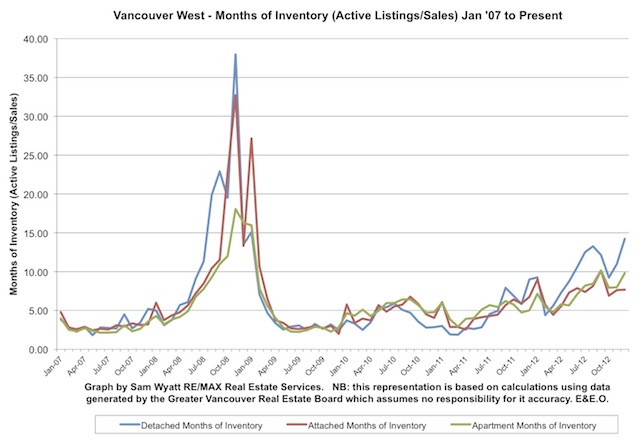
Months of Inventory (MOI) dropped for the third month in a row for detached homes and apartments to under 6 months and for the second consecutive month for attached homes to under 5 months.  If MOI drops to under 5 months for more than a month or two, then it could herald an end to falling prices but so far the change in the MOI trend is reminiscent of the same period between January and March of last year when MOI dropped for all product types to under 5 months.   Last year those same MOI figures bounced back to high points not seen since the credit crisis - to over 14 months for detached homes. 
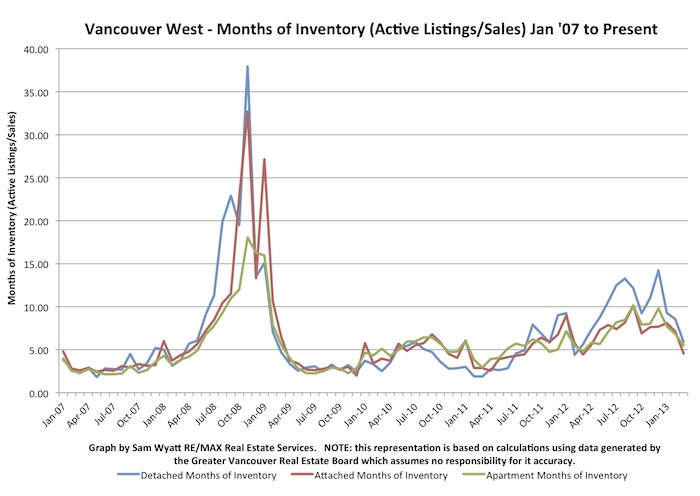
Chart - Inventory Jan 07 -_.jpg

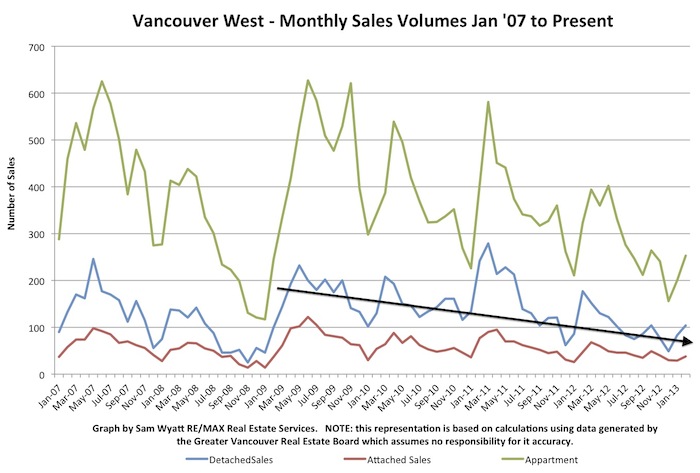
MOI was deflated in March on the Westside by increased sales volumes to more than 150 detached homes, 58 attached homes and 324 apartments.  These have been heartening times for a Realtor© (like me) after the comparatively low sales volumes of the last 6 months.  It affirms my own experience that the spring market has thus far been a good one.  If you want to sell, the time is now (or yesterday).  Keep in mind that these sales numbers are all lower than the high points (generally March) of the spring markets since 2009.  The trend since the run-up after the credit crisis has been declining sales volumes in which both the high and low seasons (Spring and Winter) have generally seen progressively fewer sales each year. 

Sales Volumes.jpg

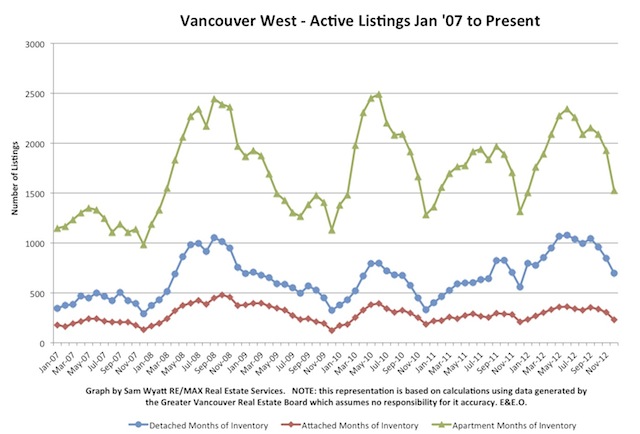
Active listings have stayed stubbornly high, particularly for detached homes which sat at 892 on March 31st.  The active listings low points in 2012 were the highest ever for annual low points for all home categories.  It will not be a surprise if active listings crack 1000 for detached homes and reach up to 2500 for apartments before the year is over.  Inversely to sales volumes, active listings' low and high points have been, for the most part, increasing progressively each year.

Active Lisitngs.jpg

The lower MOI is indicative of a typical spring market and in many ways it probably indicates that a sudden or radical drop in prices is now unlikely.  However, the longer upward trend in MOI suggests that prices will continue to fall slowly but steadily.  Unless MOI drops and stays below 5 months for a protracted period, my forecast remains that 2013 will continue to see a trend of falling prices that could extend for some time.

SELLERS (especially of detached houses): The time has come and gone to sell at the top of the market but the Spring market is the next best thing.  PLEASE DO NOT HESITATE TO CALL ME FOR A PROPERTY EVALUATION.

HPI Index.jpg

BUYERS:  Spring is bringing a dizzying volume of listings to choose from and plenty of vendors compelled to negotiate in earnest.  Throw in a 2.79% fixed rate for good measure.  If you need a long-term home it is a fun time to be shopping (though it's been tiring with so much to see).

I am presently selling ALDER CROSSING and THE WESTERLY two boutique developments in Fairview Slopes and West Kitsilano respectively.  Pricing is sharp.  At Alder Crossing Investor's Studio apartments start at $239,900 and two bedroom and den townhomes with 250 sq.ft. roof decks are priced at $769,900.  At The Westerly one bedrooms start at $319,900 and 2 bedrooms start at $469,900.  The best part is that HST does NOT apply.

Remember that Months of Inventory (MOI) is a measure derived from the number of active listings during a given month divided by the number of sales that month. It indicates the theoretical length of time it would take to sell all of the properties on the market if nothing changed. Historically, 0-5 months of inventory has generally implied upward price pressure for the ensuing six months, 5-8 months of inventory meant a flat market with respect to pricing and over 8 months of inventory has, for the most part, precipitated downward price pressure.

Do not hesitate to call me if you have any questions and please pass this and my contact information along to any friends or family who might benefit from my services.

By SAM WYATT - VANCOUVER REALTOR
Read

The Spring market has started and it promises to bring sales volumes out of oblivion for a short respite.  If you are thinking of selling, the time is now.  The timing of new record low 5-year fixed mortgage rates of 2.79% seems designed to try to give the market a boost - if only for a short while.

February's Months of Inventory (MOI) for detached homes dropped for a second month to 8.56 months.  This drop was due to increased sales volumes.  Westside house sales rose from only 83 sales in January to 104 in February.  This is heartening but active detached listings also grew from 771 to 890 and more should be anticipated over the next few months.

The trend since the run-up after the credit crisis has been declining sales volumes in which both the high and low seasons (Spring and Winter) have generally seen progessively fewer sales each year. 

Sales Volumes.jpg

Similarly, active listings' low and high points have been, for the most part, increasing progressively each year.

Active Lisitngs.jpg

The effect of these two factors is seen in the Months of Inventory, which has been trending upwards since late 2009 and more clearly since early 2011.

Chart - Inventory Jan 07 -_.jpg

This has all been happening in spite of a series of record breaking interest rates being announced over the same time period.  The latest record was just unveiled in the last week - a 2.79% fixed rate 5 year term mortgage.  Like the previous rates, this one will likely create a short term spike in sales followed by a longer term acceptance of the unbelievably low rates as the new normal.  Result:  the declining market trends will almost certainly continue.

The bottom line continues to be that prices are falling.  The Real Estate Board of Greater Vancouver's Westside detached home HPI index is down over 10% from its high point last Spring.  By end of summer I expect this to have fallen another 10%.

SELLERS (especially of detached houses): The time has come and gone to sell at the top of the market but the Spring market is the next best thing.  PLEASE DO NOT HESITATE TO CALL ME FOR A PROPERTY EVALUATION.

HPI Index.jpg

BUYERS:  Spring is bringing a dizzying volume of listings to choose from and plenty of vendors compelled to negotiate in earnest.  Throw in a 2.79% fixed rate for good measure.  If you need a long-term home it is a fun time to be shopping (though it's been tiring with so much to see).

I am presently selling ALDER CROSSING and THE WESTERLY two boutique developments in Fairview Slopes and West Kitsilano respectively.  Pricing is sharp.  At Alder Crossing Investor's Studio apartments start at $239,900 and two bedroom and den townhomes with 250 sq.ft. roof decks are priced at $769,900.  At The Westerly one bedrooms start at $319,900 and 2 bedrooms start at $469,900.  The best part is that HST does NOT apply.

Remember that Months of Inventory (MOI) is a measure derived from the number of active listings during a given month divided by the number of sales that month. It indicates the theoretical length of time it would take to sell all of the properties on the market if nothing changed. Historically, 0-5 months of inventory has generally implied upward price pressure for the ensuing six months, 5-8 months of inventory meant a flat market with respect to pricing and over 8 months of inventory has, for the most part, precipitated downward price pressure.

Do not hesitate to call me if you have any questions and please pass this and my contact information along to any friends or family who might benefit from my services.

SAM WYATT - VANCOUVER REALTOR

Read

December's Months of Inventory (MOI) for detached homes worryingly punched through to over 14 months in December but dropped back to just over 9 months in January.  Chart - Inventory Jan 07 -_.jpgIt is a difficult time of year to read too much into a single month's numbers as both listings and sales begin to climb in early spring and the pace of each is not necessarily aligned.  Increasing sales volumes outpaced the increase in active listings in January.  If you are thinking about selling, it means that February will likely be the best time in 2013 to maximize your net proceeds of sale.  Once listings volumes surge over the next several months, the increase in active listings will very probably overwhelm sales and drive the MOI up again.Sales Volumes.jpg

What remains clear is that a strong long-term trend of increasing active listings and decreasing sales volumes continues to exist.  Unless this trend is reversed then the Vancouver market will continue to see prices fall.Active Lisitngs.jpg

SELLERS (especially of detached houses): The time has come and gone to sell at the top of the market but this EARLY spring market is the next best thing.  PLEASE DO NOT HESITATE TO CALL ME FOR A PROPERTY EVALUATION.

BUYERS:  Spring will bring a dizzying volume of listings to choose from and plenty of vendors willing (or those who are compelled by circumstance) to negotiate in earnest.  If you need a long-term home it is a fun time to be shopping (though it's been tiring with so much to see).Screen shot 2013-02-02 at 2.01.54 PM.png

I am presently selling ALDER CROSSING a boutique development of 12 homes in Fairview Slopes that includes two bedroom and den townhomes with roof-decks (great views) and several studio apartments (inquire about the genuine investment opportunity here).  Framing is almost finished and these homes will be complete for this summer.  All homes are 16' wide and the townhomes are set over 2 levels for great use of space.  If you are interested please register at: www.aldercrossing.com or give me a call.

Remember that Months of Inventory (MOI) is a measure derived from the number of active listings during a given month divided by the number of sales that month. It indicates the theoretical length of time it would take to sell all of the properties on the market if nothing changed. Historically, 0-5 months of inventory has generally implied upward price pressure for the ensuing six months, 5-8 months of inventory meant a flat market with respect to pricing and over 8 months of inventory has, for the most part, precipitated downward price pressure.

Do not hesitate to call me if you have any questions and please pass this and my contact information along to any friends or family who might benefit from my services.

Sam Wyatt - Vancouver Realtor


sam wyatt
RE/MAX real estate services

www.samwyatt.com
604-722-3734

click here for my video presentation

Read

In my last report I speculated that the Months of Inventory (MOI) for detached homes would remain fairly similar, for December, to what it had been in November at about 11 months.  With only 49 sales and nearly 700 active listings, the MOI in December for Vancouver detached Westside homes jumped to over 14 months, the highest it has been since the credit crisis!   The MOI rose for apartments to just under 10 months but did remain stable for the attached market at 7.67 months.  The detached homes months of inventory figure can only be seen as a worrying confirmation of the state of Vancouver's real estate market

Chart - Inventory Jan 07 -_.jpg

Remember that Months of Inventory (MOI) is a measure derived from the number of active listings during a given month divided by the number of sales that month. It indicates the theoretical length of time it would take to sell all of the properties on the market if nothing changed. Historically, 0-5 months of inventory has generally implied upward price pressure for the ensuing six months, 5-8 months of inventory meant a flat market with respect to pricing and over 8 months of inventory has, for the most part, precipitated downward price pressure.

The typical market trend is for December to be the low point for active listing volumes and for the peak of listing volumes to be somewhere between June and September.  Similarly, sales volumes are generally lowest in December/January and peak sometime in the spring.  It is probable that the MOI will fall for a couple of months only to see the spring sales volume increases peter out and rising listings volumes drive the number back up by late summer.

Chart - Active Listings.jpg

Chart - Sales Volumes.jpg

Only hindsight will allow us to know how things will turn out.  Perhaps we will see a new influx of Chinese buying or maybe the economy will suddenly take off.  More probably, months of inventory will continue its upward trend and prices will continue to fall.

Chart - Avg Prices - Jan '07 -_.jpg

SELLERS (especially of detached houses):  Act decisively and price below the previous sales comparables.  In this market, a quick sale is the sale that will get you the most for your property.  If you bought your a house in 2009 or earlier, chances are that you will be making a good profit - so sell quickly to capture more of it.  If you bought in 2010 there is a still a possibility that you may break even - ACT NOW.  If you bought in 2011 or 2012 you will probably be loosing money - the faster you sell the more you will mitigate your loss.  PLEASE DO NOT HESITATE TO CALL ME FOR A PROPERTY EVALUATION.

BUYERS:  You have a huge inventory to choose from and plenty of vendors willing (or those who are compelled by circumstance) to negotiate in earnest.  If you need a long term home it is a fun time to be shopping (though tiring with so much to see).

I am presently selling a boutique development of 12 homes in Fairview Slopes that includes two bedroom and den townhomes with roof-decks (great views) and several studio apartments (inquire about the genuine investment opportunity here).  I am pleased to be offering brand new construction at prices that reflect the market we are in.  If you are interested please register at: www.aldercrossing.com or give me a call.

Do not hesitate to call me if you have any questions and please pass this and my contact information along to any friends or family who might benefit from my services.

By Sam Wyatt - Vancouver Realtor

Read

November was a busy month for me.  I made several sales for both buyers and sellers and also spent a week in a Financial Analysis for Investment Real Estate course put on by the CCIM Institute.  I am looking forward to the respite that December usually offers to busy realtors.

After six straight months of increasing, the Months of Inventory (MOI) for detached Westside homes fell in October but in November, the MOI for Westside Vancouver homes increased anew for all home types.  The MOI increased to 10.99, 8 and 7.63 for Detached homes, Attached homes and Apartments respectively.  It remains to be seen whether or not the rising MOI trend will continue but the effect of its protracted rise to date is evident:  prices are falling.

Chart - Inventory.jpg

Active house listings declined from 960 in October to 846 in November and it is likely that the month of December will see listing volumes drop again as the Christmas season approaches and many would be sellers put their plans on hold until the early spring.  House sales dropped too from 104 in October to 77 in November.  Again, we can expect sales volumes to diminish further in December as is typically the case.  Over 250 listings are currently set to expire in December so the number of sales in December will ultimately determine what the MOI index looks like for Westside houses at the end of the year.  If sales drop to 35 we could see an MOI over 15.  If they drop to only 60 sales it could be under 10.  Presuming a less dramatic fall in sales, I suspect that the MOI will hover near its present value of about 11 in December.  I also expect to see nearly all of the expiries re-list between late January to early March so next spring will really be the test of where this market is heading.

Anyway that you look at the pricing for detached Westside houses, they are falling.  The average sale price of a Westside house fell to $2,190,320 in November.  The median sale price of a Westside house dropped to $1,878,000 in Novemeber.   The Real Estate Board's HPI index for a "typical" Westside house was $2,029,300 for Noverber.  All of these are the lowest figures seen in nearly 2 years. 

Chart - Avg Prices .jpg

Some argue that there is "pent-up" demand and that as prices fall we will see a flurry of buying in the spring.  I believe that we will see large listing volumes in the spring and not enough demand to reverse the present downward trend. 

SELLERS:  Act decisively and price below the previous sales comparables.  In this market, a quick sale is the sale that will get you the most for your property.

BUYERS:  You have a huge inventory to choose from and plenty of vendors willing (or those who are compelled by circumstance) to negotiate in earnest.  If you need a long term home it is a fun time to be shopping (though tiring with so much to see).

I am presently selling a boutique development of 12 homes in Fairview Slopes that includes two bedrooom and den townhomes with roof-decks (great views) and several studio apartments (inquire about the genuine investment opportunity here).  I am pleased to be offering brand new construction at prices that reflect the market we are in.  If you are interested please register at: www.aldercrossing.com or give me a call.

Remember that Months of Inventory (MOI) is a measure derived from the number of active listings during a given month divided by the number of sales that month. It indicates the theoretical length of time it would take to sell all of the properties on the market if nothing changed. Historically, 0-5 months of inventory has generally implied upward price pressure for the ensuing six months, 5-8 months of inventory meant a flat market with respect to pricing and over 8 months of inventory has, for the most part, precipitated downward price pressure.

Do not hesitate to call me if you have any questions and please pass this and my contact information along to any friends or family who might benefit from my services.

Sam Wyatt - Vancouver Realtor

Read

For the first time in over 6 months, the Months of Inventory (MOI) metric for Westside Vancouver houses dropped slightly.  It had risen from 4.39 in February to 13.27 in August and in September sat at 12.14.  The big news for September is that both attached homes and apartments rose again, now to over 10 months of inventory.    Chart - Inventory.jpg

It might be that Months of Inventory has crested for detached homes but my sense is that it is still likely to get worse.  There were 86 houses sold on the Westside in September which is up from 75 in August but such a paltry number of sales can hardly be considered an improvement.  Even as sales improved, active listings increased from 995 in August to 1044 in September.  The average price of detached homes fell to $2,259,214. 

Apartments and attached homes are now really beginning to feel the chill of this falling market.  With MOI over 10 months for each of these home types, we can expect to see prices fall.  In fact, the average price of an attached westside home has fallen to its lowest point since June of 2009 to $749,668.

Chart - Avg Prices .jpg

Sales success ratios for the westside are still only about 30% which means that the vast majority of listings fail to sell.  If you want to sell, you will need to price BELOW the most recent comparable sales prices and you need to do this from the very beginning of the listing.  If you don't do this, your listing will almost certainly stagnate.  I continue to succeed in making sales happen with this technique. 

Chart - Avg Prices - REBGV.jpg  

BUYERS:  More sellers are recognizing the change in this market and beginning to negotiate in earnest.

INVESTORS:  I am now selling a development in Fairview Slopes that includes several studio apartments starting at $269,900 with projected rents that will create a cash flow positive return from day one.  If you are interested please register at: www.aldercrossing.com or give me a call.

Remember that Months of Inventory (MOI) is a measure derived from the number of active listings during a given month divided by the number of sales that month. It indicates the theoretical length of time it would take to sell all of the properties on the market if nothing changed. Historically, 0-5 months of inventory has generally implied upward price pressure for the ensuing six months, 5-8 months of inventory meant a flat market with respect to pricing and over 8 months of inventory has, for the most part, precipitated downward price pressure.

Do not hesitate to call me if you have any questions and please pass this and my contact information along to any friends or family who might benefit from my services.


By Sam Wyatt - Vancouver Realtor

Read

The Months of Inventory (MOI) metric for Westside Vancouver houses rose for the sixth consecutive month in August.  It has risen from 4.39 in February to 13.27 in AugustAttached homes rose to 8.15 and apartments rose to over 8.45 months of inventory. 

Chart - Inventory Jan 08 -_.jpg 

Things will not "get back to normal in the fall when everyone has settled back in"; in fact they will likely continue to get a lot worse.  Active listing volumes for detached Westside houses did drop slightly, to under 1000 listings and stood at 995 on August 31st, but sales dropped further to only 75 homes this month.  The average prices are actually up in the Westside; ironically, the very homes that have brought the average prices up sold for huge discounts off their list prices.  Two homes priced at nearly $14,000,000 and $16,000,000 each sold for about $12,000,000The year-to-date listing success ratio for detached homes is only 33% while a year ago this time it was nearly double at 59%.  This means that only 33% of listings are actually selling.

Chart - Avg Prices - Jan '08 -_.jpg

I continue to receive calls from people whose homes are listed for sale with other realtors asking me to help them sell their homes.  If you want to sell, you will need to price BELOW the most recent comparable sales prices and you need to do this from the very beginning of the listing.  If you don't do this, your listing will almost certainly stagnate.  I have been selling homes over the past few months using this methodology in a market where most homes are not selling at all - most for over asking or at full price.   

BUYERS:  If you have 3 dogs and a growing family, you'll likely need to buy even as prices fall.  Fortunately, there are more homes to choose from than almost anytime in the past and there are genuine opportunities to negotiate hard.

Chart - Avg Prices - REBGV.jpg

INVESTORS:  Times have been hard for investor buyers in Vancouver but I will soon be selling a development in Fairview Slopes that includes several studio apartments with projected rents that will create a cash flow positive return from day 1.  More to come soon.  If you are interested please register at: www.aldercrossing.com

Remember that Months of Inventory (MOI) is a measure derived from the number of active listings during a given month divided by the number of sales that month. It indicates the theoretical length of time it would take to sell all of the properties on the market if nothing changed. Historically, 0-5 months of inventory has generally implied upward price pressure for the ensuing six months, 5-8 months of inventory meant a flat market with respect to pricing and over 8 months of inventory has, for the most part, precipitated downward price pressure.

Do not hesitate to call me if you have any questions and please pass this and my contact information along to any friends or family who might benefit from my services.

SAM WYATT - VANCOUVER REALTOR
Read

The Months of Inventory (MOI) metric for Westside Vancouver houses rose for the fifth consecutive month in June.  It has risen from 4.39 in February to 12.51 in July.  Attached homes dipped slightly from 7.87 in June to 7.39 in July but Apartments finally rose to over 8 months of inventory in July.

Chart - Inventory.jpg   

Active listing volumes for detached Westside houses are still over 1000 listings and sales dropped to only 83 homes this month.  Please do not be deluded into thinking that things will get better in the fall or next spring.  Homes are simply not selling in the same volumes as they have been and the longer people wait to reduce prices, the larger the inventory will grow.  Average monthly sale prices are the lowest they have been in the last 12 months for both Apartments and Attached homes.  This continues to be a very serious situation.

Chart - Avg Prices .jpg

Vancouver's real estate market is getting hit hard.  Historically, sales volumes fall first and then prices fall.  We are currently in the plummeting sales volumes period.  If you are thinking of selling, DO NOT WAIT:  If you sell now, you will still be selling near the top of the market.  If you plan to sell, you will need to price BELOW the most recent comparable sales prices.  If you don't do this, your listing will stagnate.  I just sold a Westside detached home for my clients using this methodology and we were sold in days in a market where most homes are not selling at all.  Do visit my web site to view recent sales.

The only bright light for buyers in Vancouver at the moment is that for the time being there is a lot to choose from and Sellers will be very happy to see you.  If you have 3 dogs and a growing family, you'll likely need to buy even as prices fall but we can negotiate hard in this falling market. 

Remember that Months of Inventory (MOI) is a measure derived from the number of active listings during a given month divided by the number of sales that month. It indicates the theoretical length of time it would take to sell all of the properties on the market if nothing changed. Historically, 0-5 months of inventory has generally implied upward price pressure for the ensuing six months, 5-8 months of inventory meant a flat market with respect to pricing and over 8 months of inventory has, for the most part, precipitated downward price pressure.

Do not hesitate to call me if you have any questions and please pass this and my contact information along to any friends or family who might benefit from my services.

Chart - Inventory Jan 08 -_.jpg

By Vancouver REALTOR © Sam Wyatt


Read

If you have not  yet sold and want to be the smug person who tells their friends how you sold your real estate right at the top of the market, it's likely too late.  All is not lost - read on.

The Months of Inventory (MOI) metric for Westside Vancouver houses rose for the fourth month in a row in June.  It has risen from 4.39 in February to 10.57 in June!  Attached homes and Apartments rose from under 5 months in March to over 7 months in June.  Taken as a whole, these are the highest numbers for MOI since the credit crisis.  Average sale prices have so far remained relatively stable even as sales volumes have floundered.  Homes are simply not selling in the same volumes as they have been and the longer people wait to reduce prices, the larger the inventory will grow.

  Chart - Inventory Jan 08 -_.jpg

Last month I pointed out that the active listing volumes for detached Westside houses actually exceeded the highest volume during the credit crisis.  In June the number of houses actively listed was even higher at 1078.  During the credit crisis, the active listings of detached homes on the Westside never exceeded 1053 houses.  Keep in mind also that the three year average number of active detached homes listed on the Westside between January 2009 and December 2011 was only 589.  This is a very serious situation.

Active Lisitngs.jpg

One of the most influential elements of the Vancouver West real estate market has been the large proportion of sales to foreign buyers, particularly from China.  From a purely anecdotal point of view, the number of these sales has significantly diminished.  We have been in a "top-down" market were the sale of the most expensive real estate has driven up prices in the rest of the market as sellers have opted to down-size or move to less costly neighbourhoods.  By moving into lower price points, the sellers of higher priced real estate were able to drive up prices because they were relatively flush with cash compared to those making lateral or up-size moves. As a result, the closer to the entry level of the market, the fewer gains were made.  Gastown apartments have made little price gains if any over the last 3 years while detached homes have nearly doubled.  When houses prices fall, the rest of the market will almost certainly follow.

The new rules for Canadian Mortgage and Housing Corporation (CMHC) insured mortgages will have a detrimental effect on sales at the entry level of the market.   Maximum amortization periods for insured mortgages have been reduced to 25 years.  Over the past several years this maximum has fallen from 40 to 25.  The most recent move from 30 to 25 years will be the most significant in that it will exclude many first time buyers from qualifying even while interest rates are near all time lows.  If the banks follow suit and adopt the CMHC rules , as they almost always do, it will likely also dissuade many investor buyers from purchasing condos to rent out.  I predict this because the lower amortization period will significantly increase monthly mortgage costs and lower the proportion of those payments that are tax-deductible interest.

Vancouver's real estate market is getting and is going to get hit from both ends.  So, now that you are thoroughly depressed, here is the bright light:  IF YOU SELL NOW, YOU WILL STILL BE SELLING NEAR THE TOP OF THE MARKET.  If you plan to sell, you will need to price BELOW the most recent comparable sales prices.  If you don't do this, your listing will stagnate.  I am pleased that this methodology has produced 4 sales in the last 30 days for my clients in a market were most homes are not selling.  In one case we had a multiple offer with a significant over asking result and in another we negotiated a full asking price sale.  Do visit my web site to view recent sales.  

Remember that Months of Inventory (MOI) is a measure derived from the number of active listings during a given month divided by the number of sales that month. It indicates the theoretical length of time it would take to sell all of the properties on the market if nothing changed. Historically, 0-5 months of inventory has generally implied upward price pressure for the ensuing six months, 5-8 months of inventory meant a flat market with respect to pricing and over 8 months of inventory has, for the most part, precipitated downward price pressure.

Do not hesitate to call me if you have any questions and please pass this and my contact information along to any friends or family who might benefit from my services.

BY SAM WYATT - VANCOUVER REALTOR


Read

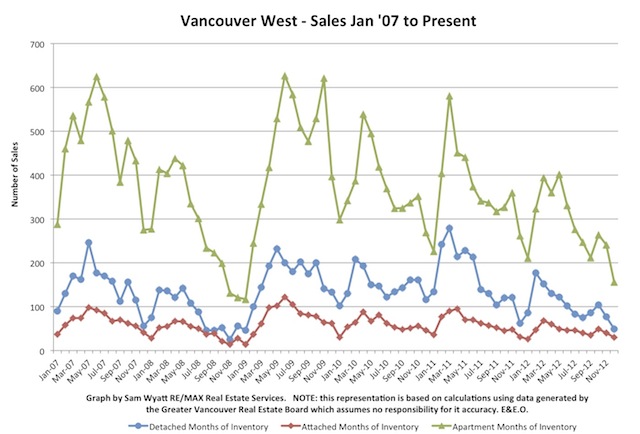
The Months of Inventory (MOI) metric for all West side Vancouver home types rose again in January.  The Detached MOI remains over 9 months, Attached surged to 8.98 and Apartments jumped to 7.1.   This is a very disturbing trend that indicates a falling market over the next 6 months.  This inventory is building in spite of the lowest fixed mortgage rates in history.

Listings grew month over month from December but sales volumes did not meet the pace.  In January we had 796 active detached homes for sale on the West side but only 86 sales.  Compare that to January 2011 where we had 402 listings but 134 sales.   Last month I said that if things continue like this then the market will be in for tough times.  Over nine months of inventory a second month in a row does not bode well.

Some of you may be saying to yourself that you've heard this before and the market went up anyway so why worry now.  Take a look at the January 2008 to present Months of Inventory graph and ask yourself if you feel lucky.

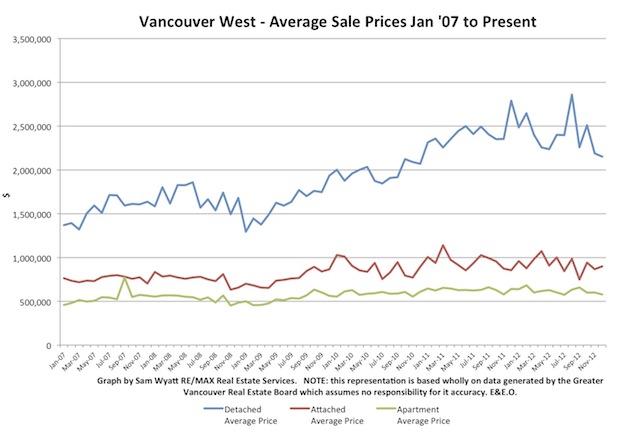
If you need or want to sell a property in the next couple of years, I strongly urge you to sell now.  Be aware that it takes time for pricing to fall to match the inventory levels because sale prices are established based on previous sales comparables and although far fewer sales are taking place the ones that sell are getting close to previous sales values.  Don't be fooled into trying to list high and negotiate down in this kind of market and don't wait to sell until after the media starts publishing the bad news.   Many listings have been stagnating while sharply priced homes are still selling fast - this is crucial to maximize your profit from a sale.

Remember that Months of Inventory (MOI) is a measure derived from the number of active listings during a given month divided by the number of sales that month. It indicates the theoretical length of time it would take to sell all of the properties on the market if nothing changed. Historically, 0-5 months of inventory has generally implied upward price pressure for the ensuing six months, 5-8 months of inventory meant a flat market with respect to pricing and over 8 months of inventory has, for the most part, precipitated downward price pressure.

Do not hesitate to call me if you have any questions and please pass this and my contact information along to any friends or family who might benefit from my services.

By Sam Wyatt - Vancouver Realtor
MOI Feb 12
Avg Price Feb 12

Read

The Months of Inventory (MOI) metric for all Westside Vancouver home types rose in December.  The Detached MOI rocketed to 9 months, Attached increased to 6.74 and Apartments to 5.02.   I was anticipating a drop in the MOI as many listings were pulled from the market for the holidays.  This has not been the case.

Although fewer new listings came to the market and many fell off the market, those drops in inventory could not hide the low relative volume of sales.   In December of 2009 133 westside detached homes were sold, in December of 2010 116 and in December of 2011 only 62.   Nine months of inventory is in the theoretical Buyer's market territory so if the coming months bring a glut of new listings then things could get a lot worse.  On the other hand sales volumes might reel in the slack.  We will need to watch and see what happens in the next couple of months.  For now, the trend towards higher inventories seems likely to continue.

Anecdotally, there is a real mixed bag of activity in the market.  All of my own listings sold in December save one which we pulled and will relist shortly.  Demand for entry level condos has been decent due to the relatively low increases in pricing compared to the detached market.  Comparatively good deals for leasehold detached properties have also attracted some activity.  Leasehold condos at UBC have been trading at virtually the same as if they where freehold while pre-paid leases (until 2074) on the Musqueam lands have sold for significantly less than their freehold counterparts.  Many listings have been languishing while sharply priced homes are still selling fast.

Remember that Months of Inventory” (MOI) is a measure derived from the number of active listings during a given month divided by the number of sales that month. It indicates the theoretical length of time it would take to sell all of the properties on the market if nothing changed. Historically, 0-5 months of inventory has generally implied upward price pressure for the ensuing six months, 5-8 months of inventory meant a flat market with respect to pricing and over 8 months of inventory has, for the most part, precipitated downward price pressure.

Do not hesitate to call me if you have any questions and please pass this and my contact information along to any friends or family who might benefit from my services.

By Sam Wyatt - Vancouver Realtor
Chart - Inventory.jpg
Chart - Avg Prices .jpg

Read

The Months of Inventory (MOI) metric for all Westside Vancouver home types fell in November.  The Detached MOI now sits at 5.83, Attached at 5.9 and Apartments at 4.74.   Average monthly sale prices fell marginally again for Attached homes and Apartments but remained flat for Detached homes in November.

Fewer new listings are the predominant reason for the drop in MOI.   This seasonal trend will likely continue for the month of December and possibly January as more people opt to wait until after the holiday season to list their homes for sale.  The Months of Inventory numbers have declined over the last two months but they are still relatively high compared to the preceding 12 months.  Average sale prices will likely continue to stagnate or trend downwards slowly over the next several months.

One of the questions I've heard of late is whether Vancouverites should expect deflation or inflation moving foward.  I've spent a fair amount of time reading articles on the subject and one thing seems clear - there is no consensus.  In the short run, many economists argue that the market is betting on deflation as investors shift their capital into US Treasury Bills.  It seems that it is only when economists are asked about the long term that inflation is more often seen as the likely outcome though very few appear to believe it would be a "hyperinflation" situation.   "Quantatative easing" in the United States and similar actions yet to be full implimented in the European Union are often cited as the prospective cause.  Real Estate is often seen as a safe place for wealth in an inflationary market but it should be remembered that highly leveraged real estate can be risky.  Interest rates are historically very low at the moment and are more likely than not to stay  that way in the short run.  But imagine a family taking out a 5 year fixed term $1,000,000 mortgage today at 3.29% for 35 years - what will happen if interest rates are 5.29% or higher at the end of 5 years when the loan needs to be renewed?  Prices for most things will be up - will wages rise with inflation?  Real Estate can be a safe asset in an inflationary market if you own it outright or have very little debt.

Remember that Months of Inventory” (MOI) is a measure derived from the number of active listings during a given month divided by the number of sales that month. It indicates the theoretical length of time it would take to sell all of the properties on the market if nothing changed. Historically, 0-5 months of inventory has generally implied upward price pressure for the ensuing six months, 5-8 months of inventory meant a flat market with respect to pricing and over 8 months of inventory has, for the most part, precipitated downward price pressure.

Do not hesitate to call me if you have any questions and please pass this and my contact information along to any friends or family who might benefit from my services.


Vancouver Realtor - Sam Wyatt - 604-722-3734November - Months of InventoryNovember - Average Sale Prices

Read
Reciprocity Logo The data relating to real estate on this website comes in part from the MLS® Reciprocity program of either the Greater Vancouver REALTORS® (GVR), the Fraser Valley Real Estate Board (FVREB) or the Chilliwack and District Real Estate Board (CADREB). Real estate listings held by participating real estate firms are marked with the MLS® logo and detailed information about the listing includes the name of the listing agent. This representation is based in whole or part on data generated by either the GVR, the FVREB or the CADREB which assumes no responsibility for its accuracy. The materials contained on this page may not be reproduced without the express written consent of either the GVR, the FVREB or the CADREB.